Loading
Industrial Design & engineering

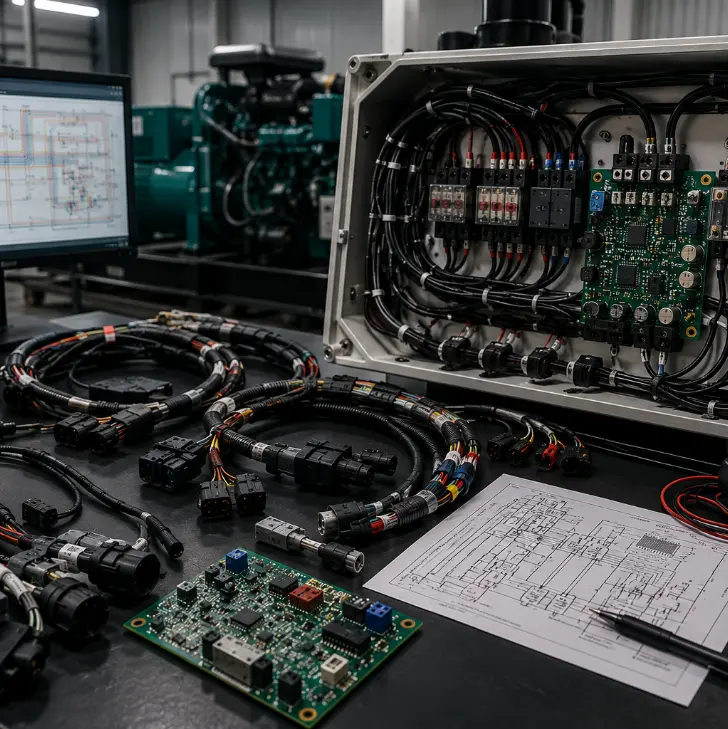
Reverse engineering to mass production — complete harness redesign for a diesel generator system

Zero
Original drawings available at start
Full
Electrical & manufacturing documentation delivered
End-to-End
Prototype to mass production support
Custom
Harness designed for system-specific requirements
The Challenge

A diesel generator system with no drawings, no documentation, and a need to scale.

Diesel generator systems are complex electrical environments. They integrate power generation, engine control, sensor monitoring, protection circuits, and auxiliary systems all connected through a harness that must handle everything from high-current power distribution to millivolt-level sensor signals, in an environment characterised by heat, vibration, and continuous duty cycles.

The client in this programme had a working system but no formal documentation. No original connection drawings, no defined current requirements per circuit, no specification for wire parameters, and no manufacturing drawings that could support either customisation of the system or a transition to reliable mass production.

They needed a manufacturing partner who could start from the physical system, work backwards to a complete engineering understanding, and then build forwards to a fully documented, producible harness programme. That is exactly what our design engineering team was engaged to do.
Our approach
01

System understanding & reverse engineering

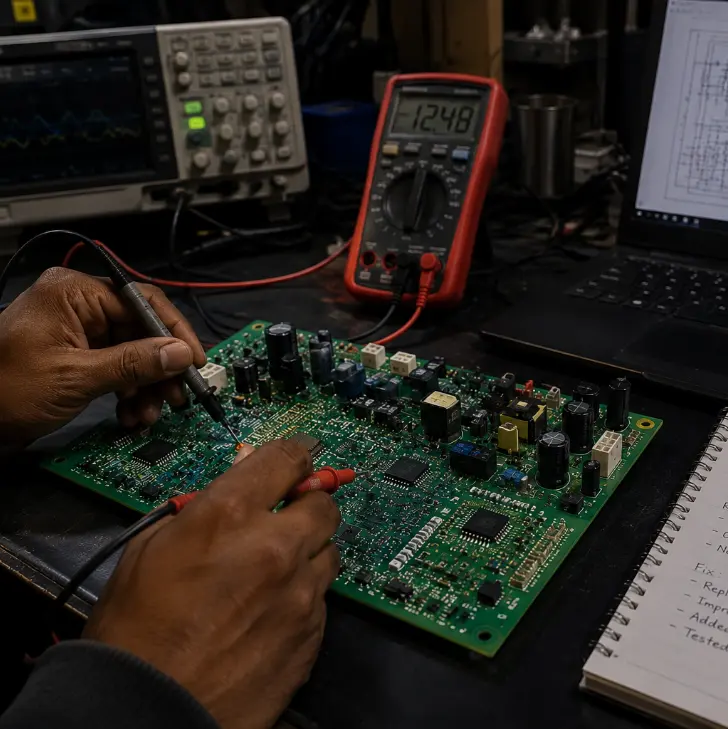
Our engineering team began by thoroughly understanding the existing diesel generator system tracing every circuit, identifying every connection point, and mapping the complete electrical topology of the harness before any design work began. This foundation is non-negotiable; assumptions made at this stage compound into expensive errors downstream.

02

Connection & current requirement definition

Every link in the harness defined – what it connects, what current it carries, what voltage it operates at, and what its functional role is in the system. For a diesel generator, this spans high-current starter circuits, alternator output wiring, engine control signals, protection relay circuits, and instrumentation links — each with distinct requirements.

03

Wire parameter selection

Wire gauge, insulation material, temperature rating, and flexibility requirements selected for every circuit based on the actual current carrying requirement, the operating temperature of the installation environment, and the mechanical demands of a continuously running diesel generator installation.

04

Sensor output analysis & voltage drop calculation

Every sensing link in the system analysed sensor output voltage, signal type, and the acceptable voltage drop across the harness run. For a diesel generator, accurate sensor signals are critical to protection system performance; a miscalculated voltage drop can cause nuisance trips or, worse, missed fault conditions. Each link was verified against acceptable limits before wire parameters were finalised.

05

Connection routing & harness bunching design

With parameters defined for every circuit, the full harness routing and bunching layout was designed – grouping circuits by function and electromagnetic compatibility, defining bend radii, fixing points, and protection requirements, and ensuring the complete harness assembly could be manufactured consistently and installed correctly every time.

06

Electrical diagrams & manufacturing drawings

Complete electrical connection diagrams and detailed manufacturing and assembly drawings prepared , providing the full documentation package needed for repeatable production, quality inspection, customisation support, and future engineering changes without starting from scratch again.

07

Sample manufacturing & mass production

Prototype harnesses built to the new design and validated against the system before production release. On confirmation, we transitioned seamlessly to mass production of the developed harness with the same team that designed it managing the production programme.

What made this engineering work
The details that matter in diesel generator harness design.
Voltage drop is not optional
In a diesel generator system, protection relays and sensors depend on accurate voltage levels. We calculated voltage drop for every sensing link not just the high-current ones before finalising any wire gauge.
Bunching affects EMI performance
How circuits are grouped in a harness affects electromagnetic interference between them. Signal circuits bundled with power circuits without proper separation create noise that degrades sensor accuracy and control system performance.
Documentation enables customisation
One of the client's key needs was the ability to customise the system. Without complete drawings and connection diagrams, every customisation becomes a new reverse engineering exercise. Full documentation eliminates that cost permanently.
Design-to-manufacture continuity
The same team that designed the harness manufactured it. That continuity means manufacturing decisions were built into the design not discovered as production problems after the drawings were handed over.
The Outcome

A diesel generator system that existed only as a physical installation with no drawings, no defined current requirements, and no manufacturing documentation was fully reverse-engineered, redesigned, and documented by our engineering team. The client received a complete harness programme: electrical connection diagrams, manufacturing and assembly drawings, validated prototype samples, and ongoing mass production support. A system that previously couldn’t be reliably reproduced or customised is now fully producible and documented.

Zero → Full
Documentation created from scratch
End-to-End
Design through mass production
Custom
Supports ongoing system customisation

Related Case Study

Zero field failures across a 50,000-unit medical PCB programme with full regulatory audit compliance.

August 7, 2026

EOL component crisis averted — programme kept running 3 more years without redesign.

August 7, 2026

Stay updated on EMS trends and engineering breakthroughs.


    Why this matters

    Many industrial systems in operation today were built without formal harness documentation either because the original drawings were never created, or because they’ve been lost over years of modifications and upgrades. That absence creates a hidden cost: every repair, customisation, or production run becomes more expensive and more error-prone than it needs to be.

    This programme demonstrates our ability to start from a physical system and build a complete engineering foundation that makes the system genuinely producible at scale. It’s a capability that applies equally to diesel generators, industrial control systems, oil and gas equipment, and any complex electrical system that needs to move from one-off to repeatable.

    Related Case study
    Explore more of our precision engineering success stories.

    Mission-critical ruggedised electronics programme — zero failures across operational deployment.

    IoT consumer product – 20,000 retail-ready units delivered in 10 weeks with zero 90-day returns.

    Rolling stock control electronics — zero in-service failures across 3-year deployment.