Loading
Industrial Design & engineering

From recurring field failure to permanent fix: debugging a motor control PCB under pressure

2
Motor types controlled
Root Cause
Identified & validated
2-Path
Fix: field + new production
The Challenge

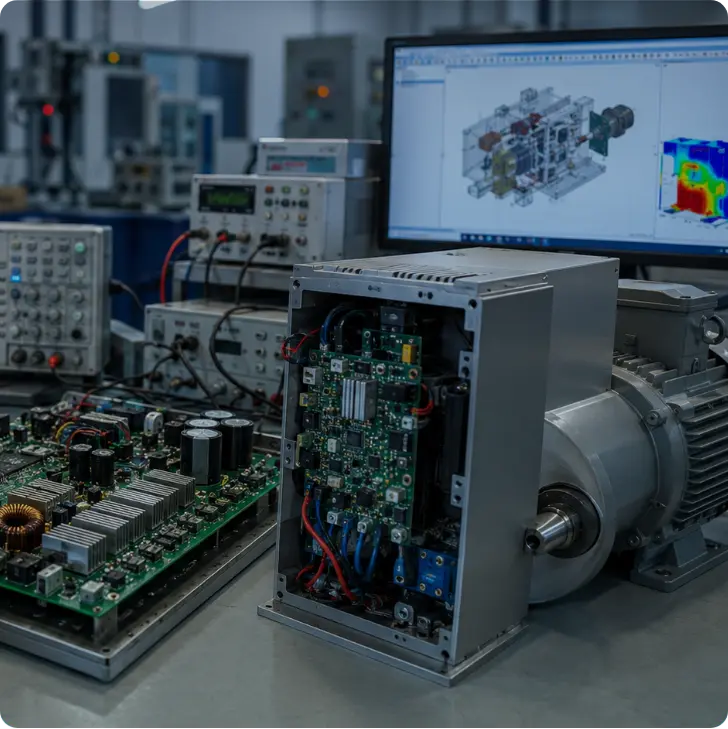
A machine combining AC and DC motors relied on a single control PCB referred to on the floor as the Control PCB or CPU PCB to manage the entire motor system. This board had developed a pattern of failures once deployed in the field, well after the machines had already reached customer sites.

Field failures on a control board are a particularly difficult class of problem. The conditions that trigger the fault rarely show up cleanly on a bench, the cost of getting the fix wrong is high because any change has to work across machines already running in the field as well as new units still in production and every day the root cause stays unknown is another day of risk for the customer’s operation.
Our approach
01

Replicate the failure in lab conditions

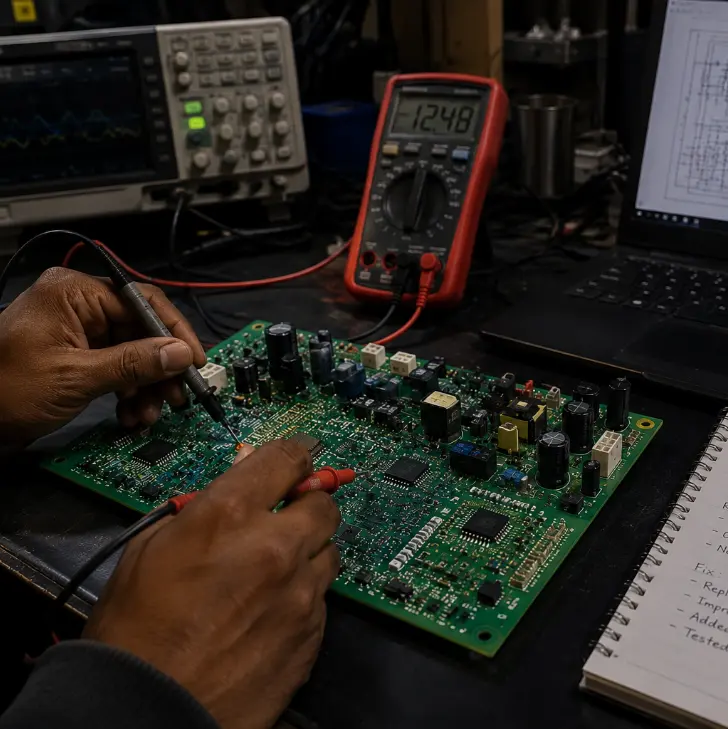
The first and most critical step. A field failure that can’t be reproduced in the lab can’t be properly diagnosed. Our team worked to recreate the exact failure conditions on the bench before attempting any analysis.


02

Fault finding & root cause analysis

With the failure reproduced reliably, we moved into systematic fault finding, isolating the failure point on the board and tracing it back to its underlying cause, rather than the first visible symptom.

03

Define resolution paths for two scenarios

Once the root cause was clear, we worked out two distinct resolution paths because a field failure problem isn’t solved by just fixing the next unit off the line.

04

Validate the changes

Before any fix was finalised, the proposed changes were validated against the original failure conditions confirming the fault no longer reproduced under the same conditions that originally caused it.

Two-part resolution
A genuine field failure fix has to work in two directions at once - backward, for machines already sold and running, and forward, for everything still coming off the production line.
Scenario 1 — Machines already in the field

A corrective action path was defined for machines already deployed at customer sites addressing the immediate failure risk on units already in operation without requiring a full board replacement programme.

Scenario 2 — New production going forward

A permanent design fix was built into new production incorporating the component and layout changes directly into the manufacturing process so the same failure mode could not recur in future units.

The Fix

Root cause analysis traced the failure to an underrated component on the control board – a part operating closer to its limits than the application actually demanded, given the demands of driving both AC and DC motors from the same control system.

  • Component rating revised to provide adequate margin for actual operating conditions
  • Corresponding PCB layout changes made to accommodate the updated component specification
  • Changes validated against the original failure conditions before being signed off as the permanent fix

This is the kind of fix that looks simple in hindsight – a component rating change and a layout adjustment but only becomes simple once the actual root cause has been correctly identified. Get the root cause wrong, and even a well-executed redesign won’t solve the problem in the field.

The Outcome

The recurring field failure was traced to its true root cause – an underrated component and resolved with a two-path fix: a corrective action for machines already in the field, and a permanent component and PCB layout change for all new production. The fix was validated against the original failure conditions before rollout, giving the client confidence that the issue was genuinely closed, not just patched.

Related Case Study

Industrial motor drive PCB programme – thermal validated, HiPot cleared, zero field returns.

August 7, 2026

Zero field failures across 50,000 medical PCB assemblies through multi-stage integrated testing.

August 7, 2026

Zero field failures across a 50,000-unit medical PCB programme with full regulatory audit compliance.

August 7, 2026

Stay updated on EMS trends and engineering breakthroughs.


    Why this matters

    Field failures on control electronics are rarely solved by replacing the failed part and hoping it doesn’t happen again. They require the discipline to reproduce the fault under controlled conditions, trace it to a genuine root cause, and design a fix that addresses both what’s already in the field and what’s still being built. That’s the standard our engineering team applies to every debugging and failure analysis engagement.

    Related Case study
    Explore more of our precision engineering success stories.

    Mission-critical ruggedised electronics programme — zero failures across operational deployment.

    IoT consumer product – 20,000 retail-ready units delivered in 10 weeks with zero 90-day returns.

    Rolling stock control electronics — zero in-service failures across 3-year deployment.