Loading
PCB Assembly Electronics

PTH to hybrid SMD redesign – 450-component BOM converted to 70% SMD for better stability and lower cost.

450
Component BOM size
70%
Components converted to SMD
Hybrid
SMD + leaded PCB delivered
Cost ↓
Assembly cost reduced
Stability ↑
Improved thermal & electrical performance
The Challenge

An ageing through-hole design holding a product back.

Through-hole PCB technology was the standard for decades and for good reason. PTH components are robust, easy to inspect, and straightforward to hand-solder. But as a primary assembly technology in a modern production environment, a fully leaded design carries real disadvantages that compound over time.

The client came to us with an existing product built around a through-hole PCB with a 450-component BOM. The design was functional, but it had accumulated the limitations of its era: larger board footprint than necessary, higher assembly time and cost due to the labour intensity of through-hole placement, and components that were increasingly difficult to source as the electronics industry continued its long shift toward surface-mount equivalents.

The objective was clear – convert as much of the design as possible to SMD, replace ageing components with better modern equivalents where the opportunity existed, and deliver a redesigned PCB that was more stable, more cost-effective to produce, and better suited to automated assembly. Without changing what the product did.

Our approach
01

Full BOM analysis & component mapping

Every component in the 450-part BOM reviewed individually assessing whether an SMD equivalent existed, what the electrical parameters required, and whether the component was a candidate for replacement with a more modern, more stable, or better-sourced alternative.

02

SMD equivalent selection & validation

For every PTH component identified for conversion, an SMD equivalent selected and validated against the original specification ensuring electrical performance, thermal rating, and mechanical compatibility with the new layout before the redesign proceeded.

03

Component replacement for stability & cost

Where the redesign presented the opportunity, ageing or sub-optimal components were replaced with better modern equivalents improving thermal stability, reducing failure modes, and in several cases reducing BOM cost through more competitive modern pricing.

04

Full PCB redesign – hybrid layout

The PCB was redesigned from scratch around the new hybrid component mix optimising component placement for thermal management, signal integrity, and assembly efficiency. Through-hole components retained where SMD conversion was not technically appropriate or cost-effective.

05

DFM review & validation

The redesigned PCB reviewed against DFM criteria for the hybrid assembly process ensuring SMD pad dimensions, solder paste apertures, component spacing, and wave solder requirements for retained PTH components were all correctly specified for reliable, repeatable production.

Engineering decisions worth understanding
Why hybrid and not 100% SMD.
Not every PTH component should be converted
Some components — high-power resistors, large capacitors, connectors, and certain transformers are better in through-hole for mechanical strength and thermal handling. Converting them to SMD would reduce reliability, not improve it.
70% is the right target here
A 70% SMD conversion on a 450-component BOM represents a significant shift in assembly economics while retaining PTH where it genuinely belongs. Pushing to 100% would have compromised the design for marginal additional benefit.
Component replacement compounds the benefit
Redesign creates the opportunity to update components that were selected years ago. Modern equivalents often offer better tolerance, lower failure rates, and improved sourcing benefits that compound across every production run.
DFM built into the new layout
A hybrid PCB has more complex assembly requirements than a pure SMD or pure PTH design. Getting the DFM right at design stage prevents yield problems that would otherwise only surface in production.
The Outcome

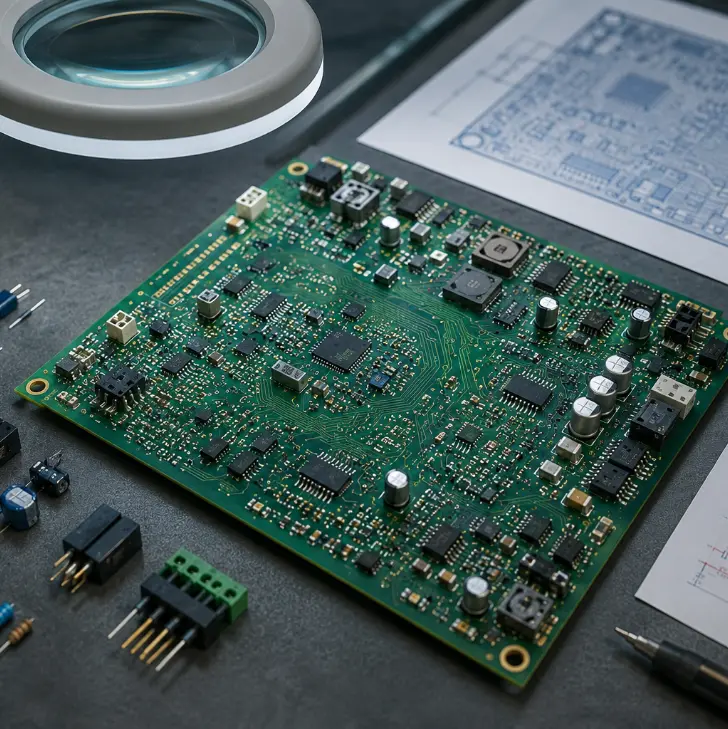
A 450-component through-hole PCB design was fully redesigned by our electronics engineering team converting 70% of components to SMD in a hybrid layout, replacing ageing components with better modern equivalents, and delivering a PCB that achieves the client’s cost-down objective with improved thermal stability and modern assembly compatibility. The redesigned board is more manufacturable, more cost-effective to produce, and better positioned for the product’s next phase of its commercial life.

450
Component BOM redesigned
70%
Converted to SMD
Cost ↓
Assembly cost reduced
Stability ↑
Improved vs original design

Related Case Study

Zero field failures across 50,000 medical PCB assemblies through multi-stage integrated testing.

August 7, 2026

Industrial IoT gateway from prototype to 5,000 deployed units in 12 weeks

August 7, 2026

IoT consumer product – 20,000 retail-ready units delivered in 10 weeks with zero 90-day returns.

August 7, 2026

Stay updated on EMS trends and engineering breakthroughs.


    Why this matters

    There are thousands of products in Indian industry running on PCB designs that were laid out ten, fifteen, or twenty years ago before SMD became the dominant assembly technology. Many of those products work perfectly well, but they carry a hidden cost burden in assembly time, component sourcing risk, and manufacturing inflexibility that erodes margin with every production run.

    PCB redesign and technology conversion is not a one-time cost, it’s an investment that pays back across every unit produced from that point forward. And it requires an engineering team that understands both the electronics design and the manufacturing implications of every decision made at schematic and layout stage.

    That is exactly what our electronics design team brings to this kind of programme.

    Related Case study
    Explore more of our precision engineering success stories.

    Mission-critical ruggedised electronics programme — zero failures across operational deployment.

    IoT consumer product – 20,000 retail-ready units delivered in 10 weeks with zero 90-day returns.

    Rolling stock control electronics — zero in-service failures across 3-year deployment.