Shielded vs Unshielded Cable Assemblies: Pros & Cons Explained for Indian Industries
 16 Jun 2025
  5 min read
 By jinstpvtltd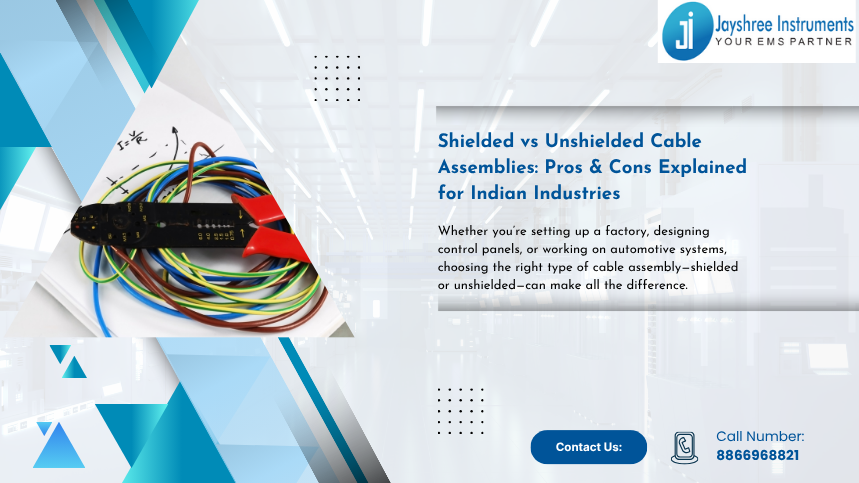
When it comes to industrial wiring and electronics, cable assemblies play a major role in keeping operations running smoothly. Whether you’re setting up a factory, designing control panels, or working on automotive systems, choosing the right type of cable assembly—shielded or unshielded—can make all the difference.
If you’re exploring options or speaking with cable harness manufacturers in India, it’s important to understand the pros and cons of both types of cable assemblies. So, let’s simplify this topic and make it easy to decide what’s best for your application.
What is a Cable Assembly?
Before we dive into shielded vs unshielded types, let’s first understand what a cable assembly is.
A cable assembly is a group of wires or cables bound together by a sleeve, conduit, or tape. These assemblies are built to handle electrical transmission efficiently and safely. Often used in machinery, vehicles, electronics, and automation systems, cable assemblies are essential for organised wiring and long-term durability.
Leading cable harness manufacturers in India, like Jinst Technologies, specialise in producing both shielded and unshielded cable assemblies depending on customer needs.
What is a Shielded Cable Assembly?
A shielded cable assembly includes a protective layer—usually made of braided copper, aluminium foil, or conductive polymer—that surrounds the inner wires. This shield acts as a barrier against electromagnetic interference (EMI) and radio-frequency interference (RFI).
Think of it like noise-cancelling headphones but for your wires!
Best used in:
- High-voltage equipment
- Data centres
- Communication devices
- Industrial control panels
- Automotive electronics with heavy EMI exposure
What is an Unshielded Cable Assembly?
As the name suggests, unshielded cable assemblies don’t have that extra protective layer. They rely purely on the insulation around each wire and are more flexible, lightweight, and cost-effective.
Best used in:
- Low-noise environments
- Simple household devices
- Office equipment
- LED lighting setups
- Consumer electronics
Shielded vs Unshielded Cable Assemblies: Key Differences
Let’s compare the two based on important features:
| Feature | Shielded Cable Assembly | Unshielded Cable Assembly |
| Interference Protection | High (EMI/RFI resistant) | Low (vulnerable to interference) |
| Construction | Thicker and heavier due to shielding | Lightweight and flexible |
| Installation | Slightly more complex due to rigidity | Easier and quicker to install |
| Signal Clarity | Better performance in noisy environments | Signal quality may drop in high EMI areas |
| Cost | More expensive due to extra materials | Budget-friendly |
| Durability | Stronger outer protection | Moderate durability |
| Common Usage | Industrial machines, automotive, defence electronics | Consumer gadgets, internal wiring, and low-power systems |
Pros and Cons of Shielded Cable Assemblies
Pros:
- Excellent EMI/RFI protection: Ideal for industries like aerospace, defence, and medical electronics.
- Stable signal transmission: No data loss or disruption in sensitive applications.
- Increased durability: The shield adds mechanical strength to the cable.
Cons:
- Higher cost: Slightly more expensive than unshielded versions.
- Less flexible: Not suitable for spaces that need tight bends or movement.
- Heavier: Adds weight, which might be a concern in automotive or aerospace setups.
Pros and Cons of Unshielded Cable Assemblies
Pros:
- Cost-effective: Perfect for budget-sensitive projects or simple wiring needs.
- Easy to install: Lightweight and flexible, suitable for compact spaces.
- Versatile: Works well in a wide range of low-interference environments.
Cons:
- Poor EMI protection: Not ideal near motors, transformers, or high-frequency electronics.
- Signal loss risks: Can affect data transmission in sensitive applications.
- Lower durability: May wear out faster in harsh or high-vibration areas.
Where Do Indian Industries Use Each Type?
Shielded Cables in India:
- Automotive sector (Pune, Chennai): Modern EVs and vehicles need EMI-protected wiring.
- Defence and aerospace (Bangalore, Hyderabad): Mission-critical systems require signal integrity.
- Heavy machinery (Gujarat, Maharashtra): Shielded cables are used around motors, drives, and PLCs.
Unshielded Cables in India:
- Consumer electronics (Noida, Bangalore): In TVs, printers, routers, etc.
- Lighting systems (Ahmedabad, Mumbai): Indoor wiring, LED lighting.
- Office automation (Gurgaon, Hyderabad): Printers, computer peripherals, routers.
If you’re working with cable harness manufacturers in India, it’s best to share your usage environment so they can recommend the ideal cable assembly type.
How to Choose Between Shielded and Unshielded Cable Assemblies?
Here’s a quick checklist to help:
Working near motors or heavy machinery? Go for shielded cables.
Need lightweight and flexible wiring in a low-EMI zone? Choose unshielded.
Using sensitive electronics where data integrity is critical? Shielded is the way.
Want to cut costs for a simple wiring project? Unshielded works just fine.
Many reputed cable harness manufacturers in India, such as Jinst Technologies, offer custom cable assemblies tailored to your project’s environment, budget, and technical needs.
Pro Tip: Hybrid Assemblies are a Smart Option
In many industrial projects, especially automation setups, engineers now prefer hybrid cable harnesses—a combination of shielded and unshielded wires within one assembly. This way, you get the best of both worlds—cost savings plus signal integrity where needed.
Talk to your wiring vendor if you think this might suit your requirements.
Final Thoughts
Both shielded and unshielded cable assemblies have their own importance depending on where and how you’re using them. Shielded assemblies are perfect for high-noise environments and critical electronics, while unshielded ones are great for routine, low-cost wiring needs.
As India’s manufacturing sector grows—especially in automotive, defence, electronics, and smart tech—the demand for quality cable assemblies is also rising. Collaborating with experienced cable harness manufacturers in India ensures you get not just the right product but also expert support, customization, and long-term reliability.