
Table of Contents
ToggleShort Description
Earwax removal myths can look harmless online, but the wrong DIY ear cleaning habit can push wax deeper, irritate the ear canal, or delay proper care. This guide explains the truth about earwax blockage, clears up whether ear candles are safe, and shows why cotton bud ear danger is real.
Blog Summary
Earwax removal myths are everywhere online, but acting on the wrong advice, whether it is cotton buds, ear candles, or viral DIY gadgets can push wax deeper, damage the ear canal, or delay the care you actually need. This guide separates fact from fiction, explains why the ear is more self-sufficient than most people realise, and shows you when to stop home remedies and seek safe, clinician-led treatment instead.
Introduction
Most ear cleaning mistakes begin with a good intention: people want quick relief from blocked ears, muffled hearing, or ear discomfort. This is because earwax forms an important component of the ear’s natural cleaning process, and any attempt to remove it forcefully usually does more damage than good.
Earwax removal myths have become common because people crave quick solutions. In reality, the ear canal and eardrum are delicate, and repeated poking, heat, suction, or pressure can create pain, infection, or injury.
For a broader myth check, ear wax myths vs facts is a useful companion page.
If you are comparing advice online, Myths & Mistakes About Earwax Removal: Why Cotton Buds and Ear Candles Can Be Dangerous is the most direct next read.
What Are Earwax Removal Myths?
Earwax removal myths are claims that sound useful or natural but are not backed by good evidence or are only safe in very limited situations. They usually fall into one of three buckets: using the wrong tool, applying too much force, or copying a viral trick without understanding the risk.
Understanding earwax myths before reaching for a tool is important, because many widely shared techniques carry real earwax removal dangers that are not obvious until the damage is done.
A simple rule helps: if a method uses heat, suction, pressure, or a sharp object near the ear canal, treat it with caution.
| Myth | Safer truth | Why it matters |
| Cotton buds clean the ear well. | They often push wax deeper. | Impaction and irritation become more likely. |
| Ear candles suck wax out safely. | There is no good evidence that they remove wax. | They can burn skin or drip residue into the ear. |
| DIY gadgets are always safer than clinic care. | Some gadgets can injure the ear canal or eardrum. | Not every tool is suitable for home use. |
| Blowing with your nose pinched is harmless. | Pressure can worsen pain or blockage. | It is not a good idea with pain, infection, or eardrum problems. |
Why These Myths Spread
These myths spread because they are easy to remember, easy to market, and often shown in short before-and-after clips. A cotton bud is cheap and familiar. An ear candle looks dramatic. A spiral cleaner or suction tool feels high-tech.
People also reach for shortcuts because a blocked ear feels urgent. That is exactly when unsafe DIY choices become more likely.
- Misinformation on social media and video platforms
- Confusion between earwax buildup and infection
- Overconfidence in household tools
- Misleading marketing for ear cleaning gadgets that appear safe but are not clinically tested
- Frustration after repeated blocked-ear episodes
Rather than trying another home remedy, searching for earwax removal near me connects you with a trained clinician who can assess the blockage properly and choose the right removal method for your specific ear.
Signs And Symptoms
Not every blocked ear is an emergency, but symptoms matter. Earwax can cause fullness, reduced hearing, tinnitus, itching, or a dull ache.
- Muffled or reduced hearing in one ear
- Fullness, ear pressure, or a blocked feeling
- Ringing or buzzing in the ear
- Itchiness or mild discomfort
- Dizziness when the blockage is significant
If pain, discharge, bleeding, fever, or sudden hearing loss appears, the problem may be more than wax and should be checked.
Risks And Complications
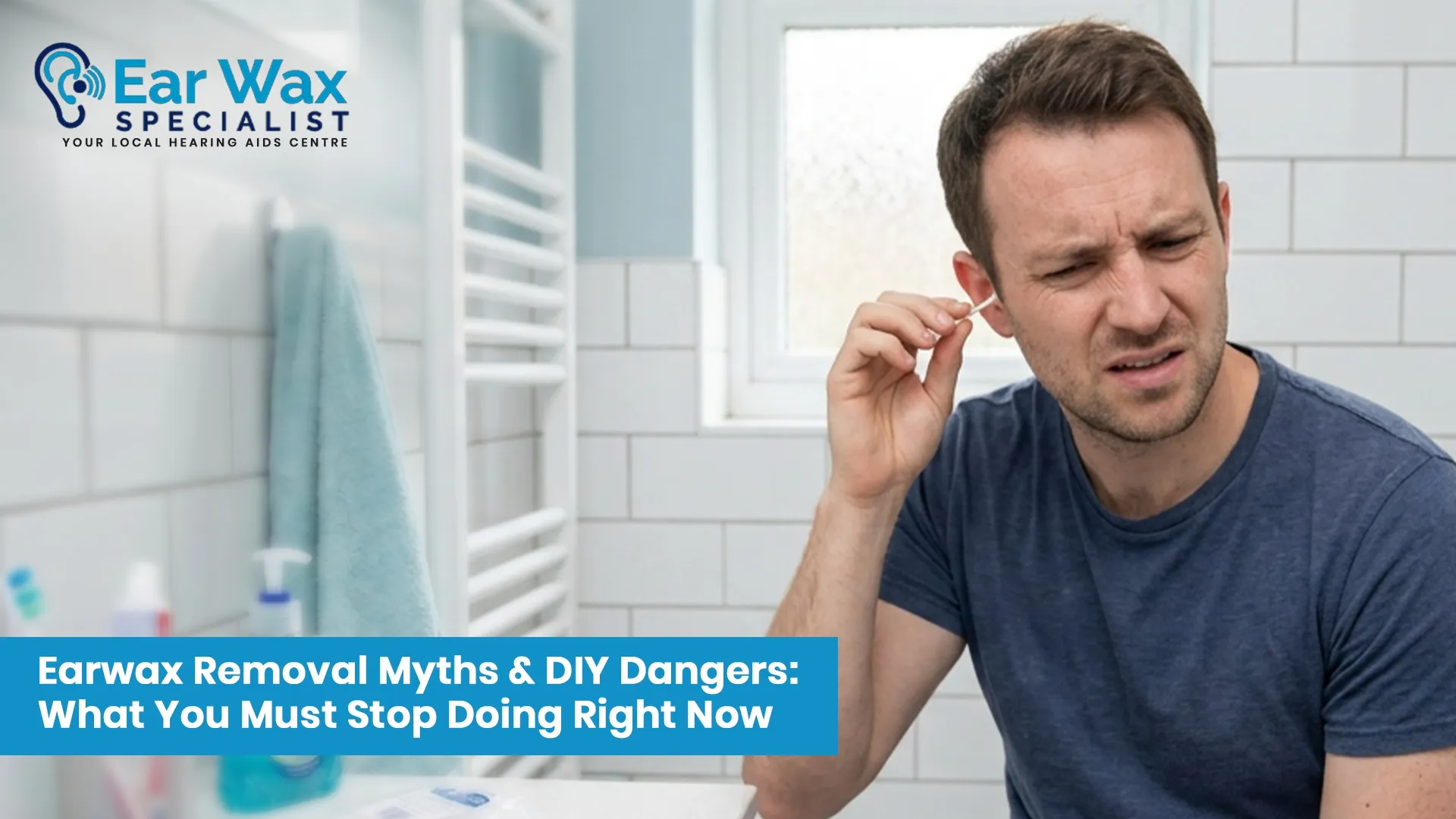
The biggest risk is often not the wax itself, but the attempt to remove it. Cotton buds and similar objects can push wax further down, compact it, or irritate the canal. The biggest risk is often not the wax itself, but the attempt to remove it. Cotton buds ear danger is well documented; these objects can push wax further down, compact it, cause ear canal injury, or irritate the canal lining significantly.
Ear candles can burn the skin or leave residue behind. Forceful pressure can also worsen pain, especially if the eardrum is already inflamed or damaged.
DIY gadgets deserve caution too. Diy earwax removal gadgets rise: safe or risky explains why popularity is not the same thing as safety.
Treatment And Safe Options
The safest option depends on how much wax is present, whether symptoms are mild or stubborn, and whether any ear history changes the plan. Softening drops or oils can work for simple cases of earwax, but they must be appropriate for the individual and the eardrum must be healthy.
Professional treatment options include irrigation, microsuction, or manual extraction. The technique used depends on the anatomy of the ear, the type of wax, and any warning signs such as an infection, ear tubes, surgery, or a hole in the eardrum. Professional care may include ear irrigation, microsuction earwax removal, or careful manual removal. A clinician chooses the right earwax treatment based on the ear canal, the wax texture, and any red flags such as infection, ear tubes, surgery, or suspected perforation.
If symptoms are affecting your hearing or comfort and you cannot wait, same day ear wax removal is available so you do not have to spend another day trying DIY methods that may make the blockage worse.
For a clearer view of specific myths, are ear candles safe for ear wax removal is a useful read.
If your main concern is pressure-based DIY advice, Is It Safe To Hold Your Nose And Blow To Clear Your Ears? covers that in more detail.
| Option | Typical use | Safety note |
| Softening drops or oil | Used first for uncomplicated wax build-up | Avoid if you have a perforated eardrum, active discharge, or recent ear surgery. |
| Irrigation | May flush wax out in the right clinical setting | Not suitable for everyone, especially with ear tubes or infection. |
| Microsuction / manual removal | Used when wax is hard or deep | Should be done by a trained clinician with proper equipment. |
| Cotton buds / ear candles / random gadgets | Not recommended | Often causes more harm than benefit. |
Prevention And Home Care
The goal at home is not to remove every trace of wax. It is to avoid turning a normal process into a blockage. The ear usually clears itself. The goal at home is not to remove every trace of wax. It is to avoid poor ear hygiene myths turning a normal process into a blockage. The ear usually clears itself, and most DIY ear cleaning attempts do more harm than good.
- Do not put cotton buds, hairpins, tissues, or similar objects into the ear canal.
- Clean only the outer ear with a soft cloth.
- Use softening drops or oil only when they are suitable for you.
- If you wear hearing aids, ask about regular ear checks.
- Get help early if one ear keeps blocking up again and again.
If you want a practical starting point, The Truth About Ear Wax – Myths Vs Facts is a good companion page before trying anything else at home.
When To Seek Help
Do not keep trying more home remedies if the ear stays blocked, pain increases, or hearing changes become sudden or one-sided.
- Sudden hearing loss
- Severe ear pain
- Discharge, bleeding, or fever
- Marked dizziness
- A history of ear surgery, ear tubes, or a known perforated eardrum
If the problem feels bigger than the amount of wax you can see, get the ear checked rather than assuming another DIY attempt will help.
FAQs
Are Ear Candles Safe?
There is no scientific evidence to suggest that ear candles help eliminate earwax. Recommendations made by leading health institutions do not include these options because they too can cause burning sensations.
Do Cotton Buds Help Clean Earwax?
No. They just make sure that earwax gets pushed deeper into the ear canal.
Are Diy Earwax Removal Gadgets Better Than Clinic Treatment?
No. While there are some that work great when certain criteria are met, others can even be hazardous or ineffective. Any symptoms that linger on must be evaluated for proper diagnosis.
Will Earwax Come Back After Treatment?
Yes. There are some people whose earwax always builds up again, particularly if they have to wear hearing aids.
When Should I Stop Home Care?
Stop using the tool if symptoms become worse, if there is pain, if there is any discharge, if there is bleeding, if you have a fever, and if you lose your hearing immediately.
For those who cannot come to clinics because of mobility issues, poor health, and other limitations, professional earwax removal at home allows you to have a safe and clinician-delivered procedure without putting yourself at risk.
Conclusion
Earwax removal myths often promise a quick fix, but the safest path is usually the least dramatic one. Cotton buds, ear candles, pressure tricks, and viral gadgets can create more problems than they solve.
Gentle care, proper assessment, and evidence-based treatment protect both hearing and comfort. If the blockage persists, or if symptoms are painful, sudden, or unusual, get a proper check rather than another round of DIY.
References
- American Academy of Otolaryngology–Head and Neck Surgery (AAO-HNS). Clinical Practice Guideline: Earwax (Cerumen Impaction) (Update) [Internet]. [Accessed 2026]. Available from: https://www.entnet.org/quality-practice/quality-products/clinical-practice-guidelines/cerumen-impaction/
- National Health Service (NHS). Earwax Build-Up [Internet]. [Accessed 2026]. Available from: https://www.nhs.uk/conditions/earwax-build-up/
- MedlinePlus; National Library of Medicine (NIH). Ear Wax [Internet]. [Accessed 2026]. Available from: https://medlineplus.gov/ency/article/000979.htm
- National Institute for Health and Care Excellence (NICE). Quality Statement 1: Earwax Removal [Internet]. [Accessed 2026]. Available from: https://www.nice.org.uk/guidance/qs185/chapter/quality-statement-1-earwax-removal
- Betsi Cadwaladr University Health Board. How to Manage a Build Up of Earwax [Internet]. [Accessed 2026]. Available from: https://bcuhb.nhs.wales/services/hospital-services/audiology/how-to-manage-a-build-up-of-earwax/
- National Institute for Health and Care Excellence (NICE). Earwax: Diagnosis and Management [Internet]. [Accessed 2026]. Available from: https://cks.nice.org.uk/topics/earwax/
- NCBI Bookshelf. Ear Irrigation [Internet]. StatPearls. [Accessed 2026]. Available from: https://www.ncbi.nlm.nih.gov/books/NBK459335/
- PubMed Central (PMC). Cerumen Management: An Updated Clinical Review and Evidence-Based Approach for Primary Care Physicians [Internet]. [Accessed 2026]. Available from: https://pmc.ncbi.nlm.nih.gov/articles/PMC6990605/
Medical Disclaimer
This article provides health information for educational purposes. It does not constitute medical advice and is not a substitute for professional medical consultation. If you are experiencing sudden hearing loss, seek immediate medical attention from your GP, A&E, or a qualified audiologist