
Table of Contents
ToggleShort Description
Bluetooth is now a standard feature in many modern hearing aids, but it is not available across every style or price point. Invisible-in-the-canal models often skip it due to size constraints, while receiver-in-canal and behind-the-ear styles are far more likely to support streaming and app control. Cheap hearing aids can work for mild hearing loss, but many budget products sold online are amplifiers rather than clinically regulated devices. This guide explains how Bluetooth hearing aids work, which styles support it, and how to choose the right device for your lifestyle and budget.
Blog Summary:
Hearing aids with bluetooth can stream phone calls, music, and TV audio directly into your ears, making everyday listening significantly more convenient but not every hearing aid includes it. The smallest invisible styles often sacrifice wireless connectivity to stay compact, while mid-range and premium models tend to offer fuller streaming and app control. Cheap hearing aids are another common consideration, but many ultra-budget products are amplifiers rather than proper medical devices, which limits how useful they are in real listening situations. This guide breaks down how Bluetooth works across different hearing aid styles, what compatibility labels actually mean, and why starting with a proper hearing test is still the smartest first step.
Introduction
Bluetooth is one of the most useful convenience features in modern hearing care. It lets many hearing aids stream calls, music and TV audio straight into your ears, while app control makes volume and programme changes far less fiddly. In the UK, that matters because RNID says around 18 million adults are deaf, have hearing loss or tinnitus, so there is no single hearing-aid setup that suits everyone. If streaming and app control are top priorities, it is worth comparing a hearing aid with Bluetooth before you decide based on price alone.
Bluetooth is not universal, though. The smallest custom devices, older aids and some budget models may skip it, so the real question is less “do hearing aids have Bluetooth?” and more “which ones do, and do you actually need it?”. That is where style, battery life and compatibility start to matter.
How Bluetooth Hearing Aids Work
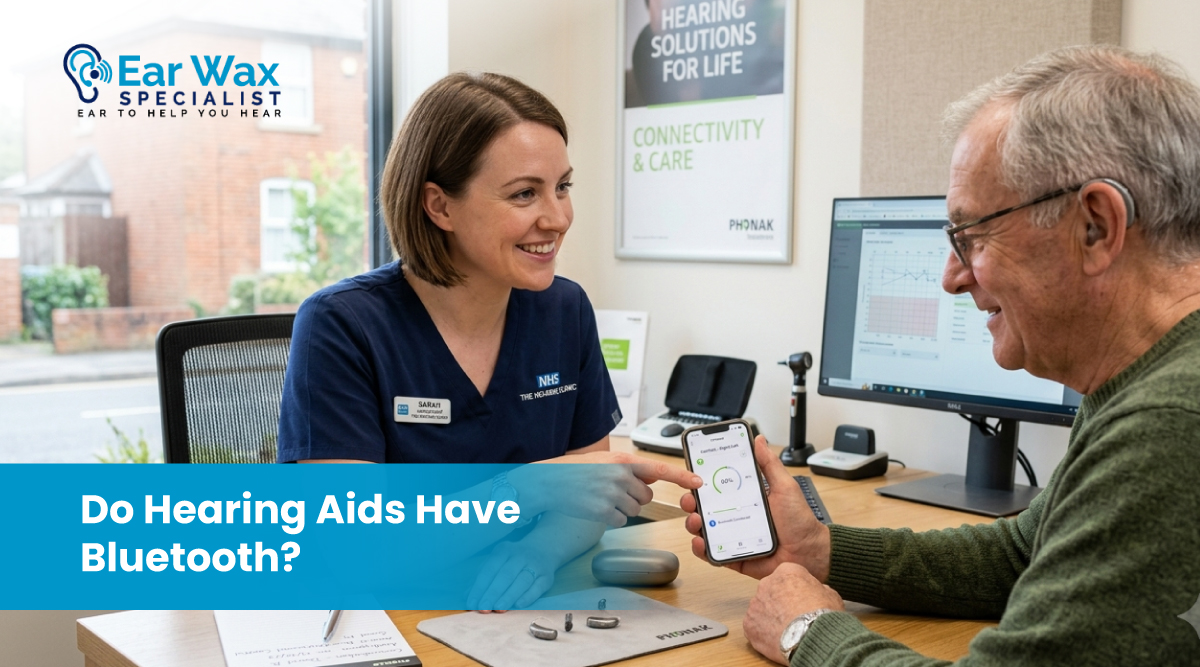
Most modern hearing aids with bluetooth can do more than simply make sound louder. They can stream phone calls, podcasts, music and TV audio directly to the ear, and companion apps let users change volume, switch programmes and fine-tune settings without touching the device. For people who spend a lot of time on the phone or in front of the television, that is a genuine quality-of-life upgrade.
Feature | What it helps with | Common caveat |
Direct streaming | Phone calls, music, podcasts and TV audio | Needs a compatible phone or streamer |
Smartphone app control | Volume, programmes and sound balance | Setup varies by brand |
Hands-free calling | Lets the microphones pick up your voice | Not every model supports it |
TV connection | Lets you listen at your preferred volume | May need a separate accessory |
Which Styles Are More Likely To Have It?
Bluetooth is common, but it is not guaranteed on every style. The tiniest invisible-in-the-canal and completely-in-the-canal designs often have less room for a wireless chip and battery, which is why comparing best invisible hearing aids UK can be helpful if discretion matters but you do not want to give up streaming entirely.
A useful middle ground is receiver in canal hearing aids. They are less visible than many full behind-the-ear options, yet they usually leave more room for connectivity and microphone placement than the smallest invisible models.
What Do Compatibility Labels Mean?
Compatibility also matters in hearing aids with Bluetooth. Some hearing aids are made for iPhone, some use Android streaming standards, and some premium models rely on Bluetooth Classic. Hearing aid streaming can also drain batteries faster, so it is worth asking how the device handles everyday use before you commit to a model. If broader phone compatibility matters, Phonak hearing aid prices UK is a useful place to start because direct connectivity is one of its well-known strengths.
Do Cheap Hearing Aids Really Work?
They can, but only if the device is the right kind of product for the right level of hearing loss. Which? warns that many very cheap products sold online are amplifiers rather than true hearing aids, while Consumer Reports explains that budget-style OTC hearing aids are intended for mild to moderate hearing loss. In plain English, cheap can work, but only when “cheap” still means properly regulated.
Device type | Typical price | What it does | Best for |
PSAP / amplifier | £20-£100 | Turns everything up, including background noise | Very limited listening help |
Budget OTC-style aid | £100-£800 | Basic hearing support with limited clinical input | Mild-to-moderate hearing loss |
Prescription / private aid | £500-£3,500+ | Custom fitted and clinically programmed | Wider range of hearing needs |
Amplifiers Are Not The Same As Hearing Aids
The easiest trap is confusing a sound amplifier with a proper hearing aid. A PSAP turns the volume up, but it does not analyse speech, reduce background noise or tailor output to your individual hearing profile. That is why very low-cost products can look tempting and still disappoint once you try to use them in real listening situations.
When A Budget Model Can Make Sense
If your hearing loss is mild and you mainly struggle with TV, phone calls or one-to-one conversation, a budget model can be a reasonable first step. The safer move is to start with a hearing test, because the NHS offers hearing tests and eligible adults can get hearing aids as a long-term loan. If you want face-to-face guidance, a Hearing aid Birmingham appointment can help you separate genuine devices from marketing noise.
Final Thoughts
Bluetooth is now common, but not universal, and the smallest invisible styles often sacrifice it in order to stay tiny. Rechargeable hearing aids have made the day-to-day experience simpler for many users, but they are still worth comparing carefully against your lifestyle before committing. Cheap hearing aids can be useful in the right circumstances, but they are not a shortcut around a proper assessment. If you want a local face-to-face review, a Hearing aid Sutton Coldfield consultation can help you weigh up Bluetooth support, comfort and budget before you buy.
The safest path is to test your hearing first with an audiologist, then choose the level of technology that matches how you live. Once you know whether you need streaming convenience, better noise handling or just a simple budget option, the decision becomes much easier.
Frequently Asked Questions
Q: Can Invisible Hearing Aids Have Bluetooth?
Some can, but the tiniest invisible-in-the-canal styles often leave too little space for a wireless chip and battery. Larger custom styles are more likely to include streaming support.
Q: Are Cheap Hearing Aids Just Amplifiers?
Often, yes. Many ultra-cheap products sold online are amplifiers rather than true hearing aids, so they make everything louder instead of improving speech clarity.
Q: Do Hearing Aids With Bluetooth Work With Iphone And Android?
Many do, but hearing aid compatibility varies. Some use Made for iPhone technology, some use Android streaming standards, and some premium models connect more broadly.
Q: Should I Get A Hearing Test Before Buying?
Yes. A hearing test tells you how much hearing you have lost and whether a budget device, a custom fitting or an NHS route is the better fit.
Q: Can I Get Hearing Aids On The NHS?
Yes, if you are eligible. NHS hearing aids are free as a long-term loan, and batteries, repairs and follow-up care are included.
References
- National Health Service (NHS). Hearing aids and implants [Internet]. NHS; Accessed 23 Jun. 2026. Available from:
https://www.nhs.uk/tests-and-treatments/hearing-aids-and-implants/
- National Health Service (NHS). Hearing tests [Internet]. NHS; Accessed 23 Jun. 2026. Available from:
https://www.nhs.uk/tests-and-treatments/hearing-tests/
- National Institute for Health and Care Excellence (NICE). Hearing loss in adults: assessment and management (NG98) [Internet]. NICE; Published 2018. Accessed 23 Jun. 2026. Available from:
https://www.nice.org.uk/guidance/ng98
- Royal National Institute for Deaf People (RNID). Hearing aids and hearing loss support [Internet]. RNID; Accessed 23 Jun. 2026. Available from:
https://rnid.org.uk/information-and-support/hearing-loss/hearing-aids/
- Royal National Institute for Deaf People (RNID). Prevalence of deafness and hearing loss in the UK [Internet]. RNID; Accessed 23 Jun. 2026. Available from:
- Which?. Are cheap hearing aids any good? [Internet]. Which?; Accessed 23 Jun. 2026. Available from:
https://www.which.co.uk/news/article/are-cheap-hearing-aids-any-good-akv4q8e0S7xN
- Consumer Reports. Complete guide to over-the-counter hearing aids [Internet]. Consumer Reports; Accessed 23 Jun. 2026. Available from:
Medical Disclaimer
This article is intended for informational and educational purposes only. It does not constitute medical advice, diagnosis, or treatment and should not be relied upon as a substitute for professional medical consultation. If you have concerns about your hearing or are experiencing symptoms such as sudden hearing loss, ear pain, tinnitus, dizziness, or changes in hearing, seek advice from your GP, NHS services, or a qualified audiologist as soon as possible.
Reviewed by:
[Audiologist Name]
HCPC Registered Hearing Aid Dispenser