
Table of Contents
ToggleShort Description
Fitting an invisible hearing aid starts with an ear canal assessment, followed by a custom impression or digital scan, and ends with a programmed device tailored to your hearing profile. IIC and CIC hearing aids are the smallest styles available, but they are not suitable for everyone, particularly those with severe hearing loss or narrow ear canals. Invisible hearing aid cost in the UK ranges from around £500 for entry-level clinical models to well over £4,500 for premium custom prescription devices. This guide covers how the fitting process works, what alternatives exist for those who need more than a standard hearing aid, and how to choose the right style for your hearing needs and lifestyle.
Blog Summary:
Invisible-in-the-canal and completely-in-the-canal hearing aids offer the most discreet fit on the market, but getting them right takes more than a quick clinic visit. The fitting process involves an ear health check, a custom ear impression or digital scan, and a programming session to match the device to your individual hearing profile. For those who need more than standard amplification, alternatives such as cochlear implants, bone-anchored hearing aids, and receiver-in-canal styles may be worth exploring depending on the type and severity of hearing loss. This guide walks through each stage of the fitting process, breaks down the cost of invisible hearing aids in the UK, and helps you work out which solution is the most practical fit for your hearing and your lifestyle.
Introduction
Invisible-in-the-canal (IIC hearing aids) and completely-in-the-canal (CIC hearing aids) hearing aids are the smallest styles available, and they sit deep in the ear canal. The NHS notes that they are barely visible, can be trickier to use, and are not usually powerful enough for severe hearing loss. Before you buy, it helps to compare the best invisible hearing aids UK so you know whether the style, power level, and handling are realistic for your routine.
How The Fitting Works
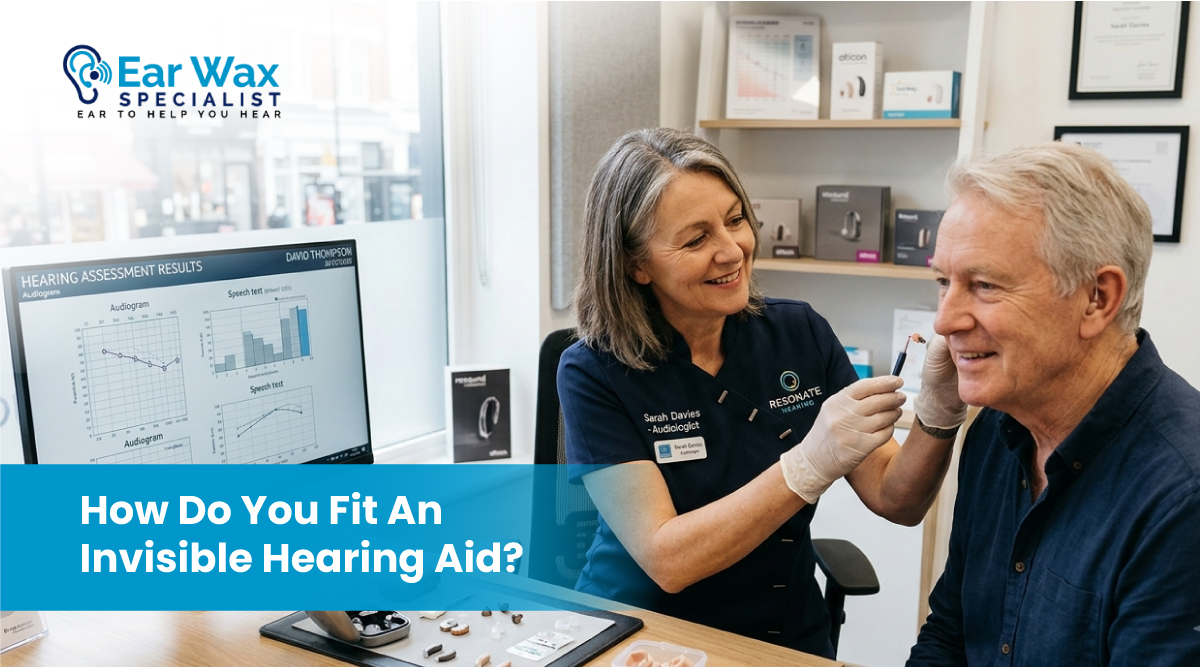
An invisible hearing aid is usually not a same-day, self-serve purchase. The first step is a hearing assessment and ear health check. A clinician looks at the ear canal, confirms the shape is suitable, and decides whether a custom model or an instant-fit option makes sense. Specsavers says invisible hearing aid fitting can come as instant-fit models worn straight away or custom-fit devices made from a mould of your ear.
Ear Canal Assessment
At the clinic, the audiologist checks the ear with an otoscope and confirms that the canal is healthy enough for a small in-ear device. This matters because the tiniest hearing aids sit much deeper than standard styles, so comfort and canal shape are part of the decision, not just the hearing prescription.
Ear Impression Or Scan
For custom CIC or IIC devices, the clinician makes a precise impression or digital scan so the shell sits securely without irritating the canal. That custom shape is what allows the hearing aid to stay discreet and stable while still matching the acoustics of your ear.
Programming And Practice
Once the device is ready, it is programmed to your hearing profile and checked for comfort and sound quality. A fitting appointment usually takes around 30 to 45 minutes, and it is also when you learn how to insert, remove, and care for the aid properly.
If you want a style that is a little easier to handle while still remaining discreet, receiver-in-canal hearing aids are often a useful middle ground.
What Is Better Than A Hearing Aid?
Nothing is universally better than a hearing aid, because the right solution depends on the type and severity of hearing loss. For some people, however, a hearing aid is only one option in a broader hearing-care pathway. If standard amplification is not enough, a cochlear implant or bone-anchored hearing system may be more suitable.
Option | Best for | Notes |
Cochlear implant | Severe to profound hearing loss | Stimulates the hearing nerve directly and can help when hearing aids no longer give enough benefit. |
BAHA / bone-anchored system | Conductive loss or single-sided deafness | Sends sound through bone conduction and bypasses the outer or middle ear. |
OTC hearing aid | Mild to moderate loss | Lower-cost, regulated devices that can be self-fitted or self-tuned. |
PSAP | Situational listening help | Not a medical hearing aid and not designed to treat hearing loss. |
The NHS says a cochlear implant may be an option if hearing aids no longer help with severe, permanent hearing loss. Bone anchored hearing aids may be considered when sound cannot reach the inner ear properly, while auditory brainstem implants are reserved for rarer cases involving the hearing nerve.
Cochlear Implants
A cochlear implant does not simply make sound louder. This is an electronic device that is surgically implanted into the body and sends signals to the auditory nerve. It is considered when conventional hearing aids are not able to give enough access to sound.
Bone-Anchored Hearing Systems
Bone-anchored hearing systems are used when sound has trouble reaching the inner ear through the outer or middle ear. Bone-anchored hearing aids operate through transmission of vibrations via the skull bones and are especially useful for conductive hearing loss and some types of single-sided deafness.
Can You Get A Hearing Aid If You Are 100% Deaf?
If both ears have no useful residual hearing, a standard hearing aid will not solve the problem on its own. In that situation, the focus usually shifts to implants or sound-routing systems. Cochlear implants are the main option when someone has severe to profound deafness in both ears, because they stimulate the hearing nerve directly instead of simply making sound louder.
If Both Ears Are Profoundly Deaf
When both ears are profoundly deaf, a specialist team may consider a cochlear implant. If the hearing nerve is absent or badly damaged, an auditory brainstem implant may be discussed in rarer cases.
If Only One Ear Is Deaf
If only one ear is profoundly deaf, a CROS hearing aid or a bone-anchored system may help by moving sound from the poorer-ear side to the better ear. That can reduce the head-shadow effect and make conversations easier to follow.
What Is The Cost Of The Smallest Invisible Hearing Aid?
Invisible hearing aid cost in the UK varies widely depending on style, technology tier, and whether the device is custom-moulded or instant-fit. The smallest invisible hearing aids are usually IIC or CIC styles, and the price can vary a lot. In the UK, some entry-level invisible models start from a few hundred pounds per pair, while premium custom options can rise into the thousands. Amplifon says its invisible hearing aid prices start from £839 to £1,479 for entry-level devices and £1,049 to £1,849 for mid-range options. Hearing Aid UK says its transparent pricing for invisible hearing aids starts from £1,095 and includes testing, fitting, custom mould, programming, and lifetime aftercare.
Tier | Typical price | What you get |
Premium custom prescription | £2,500–£4,500+ | Audiologist-moulded shells, advanced processing, and the most polished fit. |
Entry-level clinical | £500–£1,500 | Simpler custom invisible options for quieter listening needs. |
Continuous-wear / extended wear | About £3,000–£4,000 a year | A specialist option that stays in place for months and is replaced professionally. |
Premium Custom Prescription Options
The more premium custom options are usually the ones people mean when they ask about the “smallest” hearing aids. These can include advanced processing, stronger speech clarity, and a more exact fit. If you are comparing premium models, Phonak hearing aid prices UK is a useful benchmark because it shows how much price can rise once you move into specialist custom devices.
Entry-Level Clinical Options
Entry-level invisible devices are still custom-made, but they usually keep the feature set simpler and may suit people who spend more time in quiet environments. They are a sensible starting point if you want discretion without paying for the full premium feature bundle.
Continuous-Wear Options
A specialist extended-wear option, such as a Lyric-style device, is inserted by a professional and can be worn continuously for months at a time. It is the closest thing to a set-it-and-forget-it invisible solution, but it sits in its own pricing and service category.
One thing to keep in mind is that the tiniest hearing aids often sacrifice features. A hearing aid with Bluetooth is less common in the smallest IIC designs because the shell is so compact. Very small devices also tend to use tiny batteries, which means more frequent changes, and they are generally not the right match for severe hearing loss.
Final Thoughts
If you want the most discreet solution and your hearing loss is mild to moderate, invisible hearing aids can be a strong option. If you’re looking for something that’s easier to manage, more powerful, or has more features a slightly bigger model could be better. The best thing you can do is to get a hearing test and learn about your hearing characteristics and pick an aid based on these and your lifestyle preferences. For an in-person review a Hearing aid Birmingham appointment can help you compare fit, comfort and the options that make the most sense before you buy.
Frequently Asked Questions
Q: Can Invisible Hearing Aids Be Fitted At Home?
Custom invisible hearing aid fitting should be fitted by an audiologist, although you will learn how to insert and remove them yourself after the fitting.
Q: Do Invisible Hearing Aids Suit Severe Hearing Loss?
Usually not. The smallest styles are generally better for mild to moderate loss.
Q: How Long Does A Fitting Take?
A hearing aid fitting usually takes around 30 to 45 minutes.
Q: Do Invisible Hearing Aids Always Have Bluetooth?
No. The tiniest styles often leave too little space for Bluetooth hardware.
References
- National Health Service (NHS). Hearing aids and implants [Internet]. NHS; Accessed 24 Jun. 2026. Available from: https://www.nhs.uk/tests-and-treatments/hearing-aids-and-implants/
- National Health Service (NHS). Hearing tests [Internet]. NHS; Accessed 24 Jun. 2026. Available from: https://www.nhs.uk/tests-and-treatments/hearing-tests/
- National Institute for Health and Care Excellence (NICE). Cochlear implants for children and adults with severe to profound deafness (TA566) [Internet]. NICE; Published 2019. Accessed 24 Jun. 2026. Available from: https://www.nice.org.uk/guidance/ta566
- National Center for Biotechnology Information (NCBI). Hearing loss in adults: assessment and management [Internet]. NCBI Bookshelf; Accessed 24 Jun. 2026. Available from: https://www.ncbi.nlm.nih.gov/books/NBK616103/
- Amplifon UK. Invisible hearing aid prices [Internet]. Amplifon UK; Accessed 24 Jun. 2026. Available from: https://www.amplifon.com/uk/hearing-aids/costs-and-prices/invisible-hearing-aid-prices
- Hearing Aid UK. Invisible-in-the-canal (IIC) hearing aids [Internet]. Hearing Aid UK; Accessed 24 Jun. 2026. Available from: https://www.hearingaid.org.uk/hearing-aids/hearing-aid-types/invisible-in-the-canal-iic-hearing-aids
Medical Disclaimer
This article is intended for informational and educational purposes only. It does not constitute medical advice, diagnosis, or treatment and should not be relied upon as a substitute for professional medical consultation. If you have concerns about your hearing or are experiencing symptoms such as sudden hearing loss, ear pain, tinnitus, dizziness, or changes in hearing, seek advice from your GP, NHS services, or a qualified audiologist as soon as possible.
Reviewed by:
[Audiologist Name]
HCPC Registered Hearing Aid Dispenser