Table of Contents
ToggleEar care has always been a small but vital part of healthcare. For many people, blocked ears can feel like a minor issue until they disrupt hearing, balance, or overall comfort. In recent years, interest in ear care as a specialist field has grown among nurses. With the increase in demand, many people are seeking help and clarity on how to become an earwax removal specialist in the UK, and what courses and pathways to take.
Why Consider a Career in EarWax Removal?
Growing Demand Across the UK
Hearing loss linked to earwax buildup is surprisingly common. This is because GP practices across the UK regularly see patients who are looking for ear care. With NHS services stretched, and earwax removal not a core NHS service in many areas of the U.K., private clinics and pharmacies are stepping in to meet demand. The demand has created more opportunities for nurses and other health professionals who want to add a new skill to their broad scope of practice.
Opportunities Beyond the NHS
A career in ear wax removal training course doesn’t restrict nurses to hospitals. Many professionals move into private practice, community clinics and even mobile services, visiting patients at home. Outside of the NHS, this type of work can offer flexibility, more control over working hours and potentially higher income. For nurses considering a change of pace or adding new skills, ear care blends clinical knowledge with independence.
Types of Earwax Removal Training Courses in the UK
Microsuction Courses for Nurses
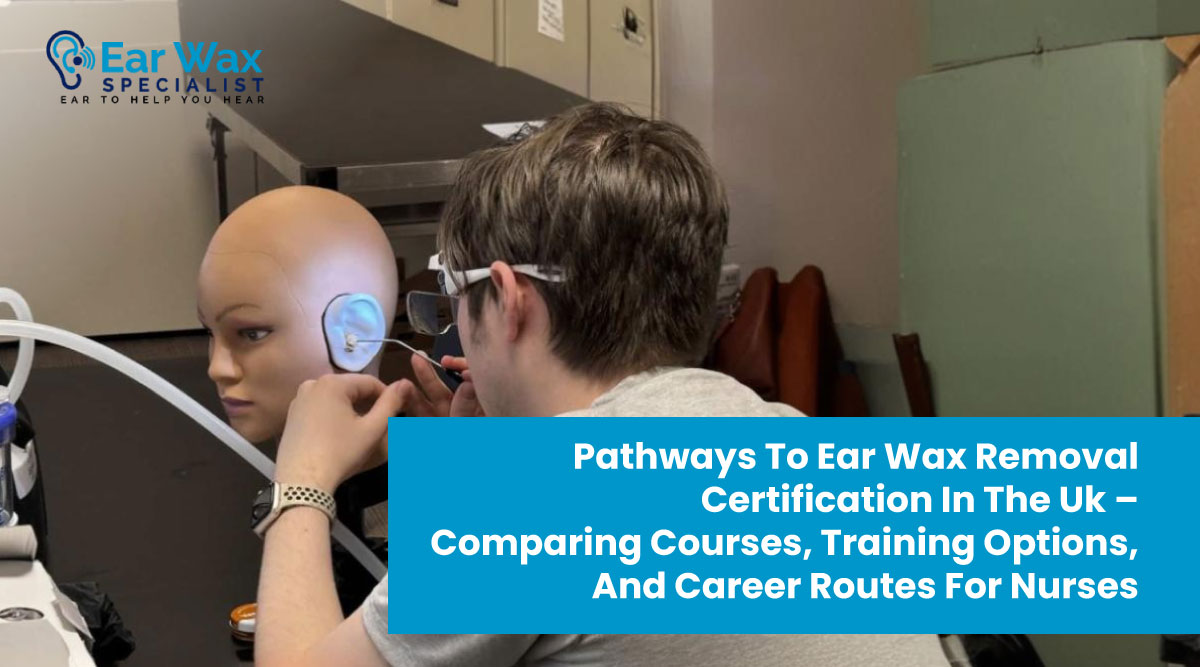
Microsuction is considered the safest and the most accurate method of wax removal. Many nurses choose microsuction courses for nurses because the procedure is done under direct vision with a microscope or loupes, making it quick and accurate. Training covers the use of specialist suction equipment, patient assessment, and safe technique. With fewer contraindications than irrigation, microsuction is often described as the current gold standard in ear care.
Ear Irrigation Courses and Syringing Techniques
Traditional syringing, which used a metal syringe to push water into the ear, is now outdated and no longer recommended due to safety risks. However, modern ear irrigation devices remain in use and are taught in many courses. Irrigation uses controlled water pressure to flush out wax safely, though it should only be carried out when no contraindications are present (such as ear infections, perforated eardrums, grommets, or a history of surgery). Learning irrigation gives nurses a solid understanding of ear care procedures, but most courses now focus on modern irrigators rather than syringing.
Ear Irrigation Nursing Procedure: What Nurses Should Know
A clear understanding of the nursing procedure is essential. As part of your accredited training, you’ll cover taking a patient history, as well as checking for contraindications, examining the ear, and explaining the procedure. You will also learn how to prepare equipment, maintain infection control, and manage complications (like dizziness or discomfort). Being confident in taking a thorough patient history and properly performing a physical examination of the subsequent ear will not only keep your patients safe but will also instil confidence in them during their care.
Choosing the Right Course: Online, In-Person, or Hybrid
Ear Irrigation Course Online vs Classroom Training
Training formats are now more flexible. An online ear irrigation course allows nurses to complete the theory at their own pace, which is ideal when balancing shifts or family commitments. Classroom-based courses, however, provide supervised practice, which is vital for building confidence in procedures like microsuction and irrigation. Some providers offer hybrid models where theory is completed online and practical training takes place in person. The right choice usually depends on personal preference, location, and how much hands-on learning is needed.
Accredited Ear Irrigation Training Courses for Nurses
Accreditation training will be beneficial for your career, as well as safe practice. When searching for ear irrigation courses, you’ll see many options, but only some are recognised for CPD and professional standards. A good course will always combine theory with supervised practice. Providers such as the Primary Ear Care Centre are well established, while some independent providers also offer accredited programmes. Completing accredited training will simplify indemnity insurance arrangements and help you work with confidence.
Ear Care Courses for Nurses: Building Specialist Skills
Earwax removal is just one procedure within the broader skill of ear care. Many courses also teach you how to recognise different conditions of the ear, like infections, what to do if you find a foreign body, and how to advise clients on ear health. Learning broader skills from your training leads to a more adaptable nurse, enabling you to support patients with ear health in both NHS and private practice.
CPD, Certification and Compliance for Practice
For most nurses, CPD points are essential. Accredited courses provide CPD hours as well as a certificate of competence. There is no separate professional register for ear wax removal courses uk – nurses remain under the Nursing and Midwifery Council (NMC), while other professionals such as audiologists or pharmacists remain under their own regulators. Certification simply demonstrates that training has met current standards, reassuring both patients and employers.
Integrating Ear Care with Broader Nursing Practice
Specialist ear care skills can be added into existing nursing roles. For example, practice nurses may include earwax removal in GP clinics, while community nurses may help patients who struggle to travel. Adding ear care as an extra skill makes nurses more adaptable and valued in different care settings.
How to Become an Earwax Removal Specialist in the UK – Step-by-Step
Check entry requirements – Entry requirements are generally consistent across courses. Most courses are open to nurses, audiologists, GPs, pharmacists, and sometimes to experienced healthcare assistants.
Choose your training – Decide whether you want to learn microsuction, irrigation or both.
Complete accredited training – Make sure the course covers both theory and supervised practice.
Organise Indemnity Insurance – This is a compulsory aspect of safe practice.
Develop your service – You can offer care in either NHS clinics, private settings or community practice.
Continue to CPD – Update any knowledge or skills as part of your continuous professional development.
Conclusion: Start Your Journey in Earwax Care Today
Recommended Training Providers in the UK
There are numerous providers in the UK specialising in ear care. The Ear Wax Specialist is well-known, but there are many accredited providers who offer training throughout the UK. Most courses typically cover both irrigation and microsuction procedures and provide practical experience. You can search online or in your local area for ear irrigation courses and narrow down your options.
Your Next Steps
The route to earwax removal begins with some clear goals. Determine which method you would like to train, check the course accreditation, and select a delivery that suits your lifestyle. Once you are trained, ear care can be offered as part of existing practice or as a new service. With the increasing demand across the UK, it is a rewarding and timely development for nurses and healthcare professionals to undertake.